
Kollmeyer Family Farm LLC
When starting this project, I made a mental list of farmers I could easily reach out to, but I was stalling in getting the ball rolling. Around this time, I went to a ribbon cutting ceremony for the relocated local MU Extension office and ran into one of my former FFA/Agriculture teachers from high school, who happened to be on my list of potential interviewees. I took it as a sign and when I approached him, he was more than happy to set up a time for an interview. Mike Graham of Kollmeyer Family Farm LLC taught in the agriculture program for 25 years and was my teacher for 2 of those years. He has since retired from teaching but now works full-time as the Livestock Specialist for the MU Extension office, where he says he continues to educate but in a different fashion. If you’re in the agriculture industry, can you ever truly retire?
Mike grew up on his family farm near Libertyville, MO as an 8th generation farmer. A few miles down the road was a neighboring farm family – the Kollmeyers. Kendra Kollmeyer met Mike on a 4-H float trip when she was around 13 and he was 15 and their story grew from there. Kendra is a proud 5th generation farmer. She also grew up knowing that she wanted to continue the family tradition of farming. Once they were married and settled, they purchased part of her family farm where they currently reside in the house her grandparents built. This farm has roughly 560 acres where they run their cow and calf operation. They also farm roughly 290 acres down the road. This portion is primarily used for hay production to feed their cattle. Finally, they help Mike’s dad, who is also a cattle producer, on his own 600-acre farm.
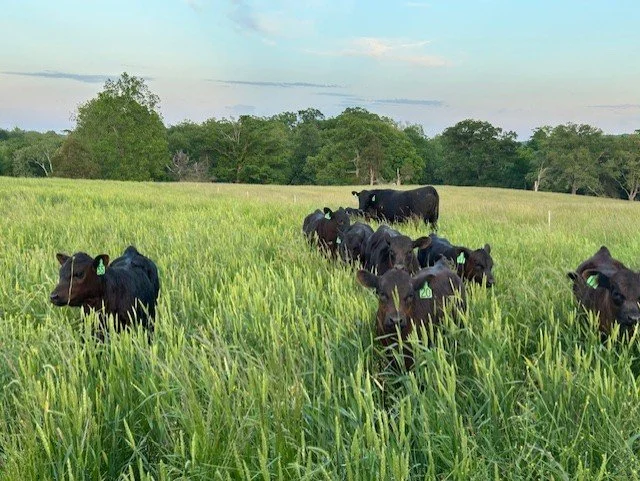
Some of the Spring calves came to say hello.
The Kollmeyer farm was historically a dairy farm that housed around 100 dairy cows. These cows could each produce up to 7 gallons of milk daily so a milk truck would come daily to collect the milk from the farm. Kendra’s grandfather and great-grandfather built a majority of the barns and outbuildings still on the land. This includes Mike and Kendra’s home that was built by her grandfather and Kendra’s neighboring childhood home that her parents still reside in that was built by her great-grandfather. This house was originally built in a back field but was later moved by horses to where it currently sits beside a highway that was put in years after.
The dairy farm has since been converted into cow and calf production and the crops once farmed have also been discarded to focus on cattle production and grass management. Around 200-250 cows are kept on the farm for calving. The calves are weaned and backgrounded for 45-60 days until they are ready to sell. Backgrounding is the intermediate phase in beef production where weaned calves are grown on forage-based diets to prepare them for feedlot finishing, improving health, growth, and feed efficiency. The rest of the cows are kept on a rotational grazing system. A rotational cattle grazing system involves dividing pastures into paddocks and rotating livestock to allow grass recovery, improving forage yield, soil health, and livestock productivity. With this, there have been around 30 plus waterers installed across the farm. Kendra was fortunate enough to have attended a class on grazing and water systems when she was pursuing her education at the University of Missouri and was able to teach her father how to install them. As part of their rotational grazing system, they exclude existing ponds in favor of using these water stations. Some waterers source their water from the existing ponds, but a majority do not. The goal of this is to prevent bacteria in drinking water and soil erosion around the ponds. Mike emphasized that their goal isn’t just to produce great cattle but to be good stewards of their land, specifically managing the land in ways that ensure the high quality and health of it and the forage it grows for their cattle.
If cattle aren’t keeping up with grazing on their primary farm, then some pastures are harvested for hay. They are not in the practice of selling hay as Mike believes there is little profit to be had, often-times finding it hard to break even given the input costs and the size of bales they produce. The hay they harvest is kept for their own cattle and they try not to have an abundance as to not have to dedicate an area to store bales for more than a season. This also goes hand in hand with managing the land. If hay is continually taken from the pastures, then those nutrients are lost that would otherwise go back into the land. In turn, fertilizer expenses would increase to put those nutrients back into the ground. If you don’t fertilize while doing hay, you take and take and will start seeing “indicator plants” that tell you your ground is struggling. Sage grass is a sharp indicator of low phosphorus or soil pH. Grazing animals such as cows help put nutrients back into the soil through their urine and feces so it is a cycle that reduces the need for extensive fertilizers. It is still important to keep an eye on the grass growing and occasionally test the soil.
I requested they take me to one of their favorite spots on the farm, which led to a side-by-side ride through several pastures to a hill with a stunning view of the surrounding fields and sunset. Unfortunately, the “shooting shack” that was originally built as a playhouse for their sons had suffered damages from a tornado in 2022, so it was unsafe to climb into for an even better view. They pointed out that they are still trying to clean up the storm damage across the farm from that tornado. They’ve also suffered damage from bad ice storms. As is common with most farms, damage control seems to be constant and there is no break from caretaking. Farming is a 24/7 job and livestock have needs - rain, sleet, snow, or tornado.
As we stood on that hill, they spoke of their operations with pride. They have dedicated years to creating better efficiency and processes for raising high quality cattle. They aim to have 2 groups of calves each year – one in the spring and one in the fall. To breed cows, they use AI (Artificial Insemination) on their first-year heifers and bulls for their experienced cows. After years in the business, they’ve adopted the policy of culling any heifers or cows that don’t produce calves within a year. They also sell cows when they are around 10 years old as they’ve found that they are less likely to produce a calf or are easily injured. These practices may seem harsh to outsiders, but as with any business, it is important to cut costs and focus on the avenues that create profitability. Farming isn’t just a hobby. It is a livelihood. As with most businesses, they put their hearts and souls into their farm and are very proud of what they’ve created. It does not come without stress, hardship, or hard decision making.
When asked what their biggest anxieties were, Mike was quick to answer that he takes his role of steward of the land very seriously to provide the best care he can to it and the cattle. When things don’t go as planned it can be hard. Kendra added that even with all the vaccines, care, and nutrition expertise, cattle still get sick or injured and sometimes mysteriously die with no warning. Storms come and wipe out trees, fences, and buildings. There is very little control over nature, but what he can control, Mike wants to take care of to the best of his ability. His mind is constantly reeling with his endless to-do list and trying to come up with a prioritized plan of where money needs to be spent and what can wait. In fact, as we were standing in the pasture, I saw a dazzling view of the farm and sunset, but what he saw were some undesirable plants growing nearby and was already making plans in his head for getting ahead next year with fertilizing – adding to that ever-growing to-do list. He stated it feels like they are always chasing their tails to catch up but thankfully now that their two sons are older, they can depend on them to help more.
Another big anxiety that has been relieved by their sons getting older involves working cattle. Whether it was successful or not, they usually have one day each round to administer vaccines and other preventative measures, and band or castrate bull calves. With the boys being older, they are more capable and there is eased tension. “Cattle can sense emotions and when you’re calmer, the cattle are calmer” – not a common reality on most farms. If you’ve ever had the pleasure of working cattle, you know that tensions are high, and unkind things are said (or yelled more often than not). “We know that if we take it out on each other or get mad, it just happens. It’s not that we don’t love each other. If we get mad while working cattle, at the end of the day we just apologize and go sit down to eat dinner, ya know. Just move on,” said Kendra. Since both Kendra and Mike grew up on farms, they are used to being around stressful situations and carrying that stress. Mike tries to focus on the positives. It is important to know what happened in the situation wasn’t directed personally but that it was the stress in the moment that created the heightened tension.
The Graham’s are fortunate enough to have had less anxiety about finances than a lot of farmers since both Mike and Kendra have always held fulltime employment off the farm. This, of course, has created a time trade-off, but they have been able to keep up with financial fluctuations. Kendra has worked at the MU Extension office since 2001 and is currently in a management position. As mentioned before, Mike was a teacher and now continues to work as a Livestock Specialist at the MU Extension. They have always dreamed of quitting their jobs and focusing solely on the farm, but just couldn’t justify doing so because of the costs. Their current hope is to build the farm up big enough that their youngest son, who has the same dream, can run the farm fulltime like they always wanted to. This creates added pressure as they are trying to create something that lasts as well as maintain the running traditions that generations before them have nurtured. The mental burden can be just as heavy as the physical one. How terrible would it be to “fail” or lose the farm that 7 generations before you have built. This is the type of pressure that affects many farmers across America negatively, leading to higher suicide rates than any other career.
Both Mike and Kendra agreed that their hardest year in farming was the year they went in with her parents to buy the farm from Kendra’s grandparents’ estate. They scaled from about 50 cows to 250. This transition period was stressful as they had to figure out the best ways to scale their expenses as well as increase the physical labor it took to look after five times more cattle than they previously had been. The same year they bought the farm there was also a bad drought, so there was constant worry about having enough forage and water to adequately sustain the land and the cattle.
When it comes to Kendra’s role on the farm, she has always been an active participant in day-to-day operations. She grew up on the farm and spent most of her childhood helping or spending time outside in a beloved creek. She pursued education as an animal nutritionist which led to her becoming the one to take care of ordering the feed, vaccines, and treating animals on their farm. She states Mike is more for the heavy lifting, mechanical, and maintenance type jobs. When asked if she ever felt resentment or struggled as a farm wife and mother, she stated that there were certainly times where she did. She was the one that still had to come in and cook dinner, clean, and take care of the house and kids after a long day of her 9-5 job as well as helping on the farm late into the evening. To combat this, she’d take the kids out on the farm with them as much as possible so she could continue to work, and there were lots of trips to McDonald’s for supper. There’s always a lot of forgiveness needed in relationships, but it is especially important when roles on the farm take priority and the days spread late into the evening. Comparing roles needs to be minimized to eliminate tension and create a happier home environment.
Kendra’s role also involves taking care of the cattle records which are in their CattleMax app while Mike does the year-end record keeping for tax season through his own spreadsheets he created. They analyze these spreadsheets to help cut costs and maneuver their budget where they need it most. This can be difficult on a farm when a piece of equipment breaks or they need new fencing. These are items that may not be in the budget, but they have to spend money on anyway. If they find something they can adjust, they do. For example, this year they are focusing on cutting their expense in minerals due to the increase in cost – hoping to spend two-thirds what they did last year. With Kendra’s nutritionist skills, they are fortunate be able to closely monitor the impact cutting minerals has on the herd and adjust where needed.
“You need to have an objective for your farm. Mine is to make sure this place gets handed down to the next generation. That’s what I think about all the time. And to do that, we need to make sure we make money and we do that by making sure we take care of our animals correctly,” said Mike. When asked what he wished more people knew about farming, he had this to say “I wish they understood that there is nobody that I’ve ever talked to that farms for a living that is trying to hide something from the general public about how we produce food and that doesn’t care substantially about the responsibility they have to provide that food. I think there are some groups that have tried to demonize agriculture.” I think we can all agree with that. He continued by saying “Most production agriculturists are introverts by nature. It’s not that they won’t talk, it’s just they won’t talk unless you ask them a question. And to them, what they do every day is what they’ve always done so they don’t understand the curiosity behind it. They’re trying to do it to the best of their ability. They have no idea why anybody would want to know anything about it. So unless somebody asks them why they do it, they’re not gonna voluntarily tell you why they do it, they just do it. I think that is the side of villainizing agriculture. As an agriculturist, we don’t do a good job of marketing why we do what we do. Our job is to produce calves and we try to do it to the best of our ability and give them the best chance of being healthy and safe. If you don’t ask me a question, I can’t answer it because I’m just used to doing what I do and it comes second-nature to us. I don’t know if I’m doing anything unique or in a way someone doesn’t understand unless they ask.”
It is far easier for a group that is focused on the negatives of farming to make posts and be active on social media “spreading awareness” than it is for farmers to give up their time to rebut these types of claims or create their own positive content. In fact, in America, 63.2% of all farmers are age 65 or older according to a 2022 USDA census. This creates a technological divide between viewers and producers. Most farmers do not market or share their operations on social media due to either their age and access to technology or they simply have no reason to do so and are more focused on running their operations and getting the long day’s work done. As more young farmers take over, we may see an uptick in positive social media exposure. However, it is not always easy for the next generation to take over. And sometimes, they don’t want to take over. This seems to be a common scenario according to the same 2022 USDA census that found that only 9% of farmers are under age 35. Mike’s dad is 74 and still farms. Like most farmers, even if he were to “retire”, he’d still play an ongoing role in farming until he physically couldn’t anymore.
“Often, kids don’t have opportunities to take over. A lot of times the parents want to portion the farm equally to their children and then when they pass, the sibling that wants to continue farming must buy out the other sibling(s) and they just can’t afford it,” says Kendra. I know from personal experience that this happens far too often. It creates a stressed or even destroyed relationship among siblings and often leads to an abandoned farm that is sold to developers or kept in family hands but not maintained. Mike, Kendra, and myself are all big advocates for Succession Planning. As Mike said, it’s a tough conversation to have with your children. It’s important to take the time to do it and to be honest with what each person wants. Thankfully for the Grahams they had no problems discussing it and creating a plan with their two sons that everyone was satisfied with and there will be no guessing or squabbles when the time comes to pass it to the next generation.
Speaking of the difficulties of starting a farm young, it is almost impossible to “buy-in” to the profession of farming. The cost to purchase the required land, livestock, and equipment can be astronomical. This creates substantial debt that may never be paid off in a lifetime. Mike states that if their son wanted to farm their combined 850 acres with a cow and calf operation, he probably wouldn’t be able to make a decent living even with it being handed down to him. However, if he is to also acquire Mike’s dad’s 600 acres, this would give him enough land and head of cattle to create a margin he could potentially rely on for himself and his own family one day. To have to buy over 1,000 acres of land plus the livestock and/or equipment to start out would be way more expensive than most aspiring new farmers could manage. Mike stated that he knew very few young people who wanted to take over their family farms and knew of none that didn’t grow up on a farm that had plans to operate one in the future.
As I was finishing the interview, I had to ask what they were most proud of as farmers. Kendra’s immediate reply was that she was able to pass it on. Being able to pay off the farm debt and pass it to her children was a tremendous victory. Being a 5th generation farmer and being able to pass it on for another generation is very encouraging and motivates her to do the best she can each day. “It would be very discouraging if we had nobody to pass this on to,” she stated. Mike whole-heartedly agreed and was also proud of how many generations before them have farmed as well as what they’ve built onto since and the ability to pass it on to one more generation. He also wanted to add in that he thinks farming may be one of the most noble professions – and I can agree. Less than 2% of Americans feed the rest of us. This was a statistic that I did not know, but Mike is passionate about and says he tries to educate people as much as he can. “Society is so far removed from farming and their food sources that they just can’t understand what goes on on a farm. One day our society is going to wake up and realize we’ve made a huge mistake,” Mike says, referring to the loss of agricultural land and lack of respect for farming. He continues, “we’ve taken up a lot of tillable ground and turned it into subdivisions and solar fields that will be really hard to turn back into agriculture ground. Experts say that in 2054 we will no longer be able to feed ourselves. That’s in my lifetime.” This is a scary thought and a reason why farmers and farmland are so detrimental to society.
Kendra ended with a bit of important advice, “It is important to keep learning. The vaccines we give now are not the ones we gave 20 years ago. We installed the grazing system after I attended a grazing class. We use a software to quickly and efficiently input and look up cattle records. You have to keep learning, reading, and talking to others.”
My hope is that this project and the voices of local farmers brings awareness to those around them that don’t understand the day-to-day life on the farm and how important it is to their daily convenience. Not only that, I hope that it opens up conversations among farmers themselves and those in the agriculture industry so that learning never stops and that we can all learn something from each other and better improve the operations on farms as well as the societal view on farming.
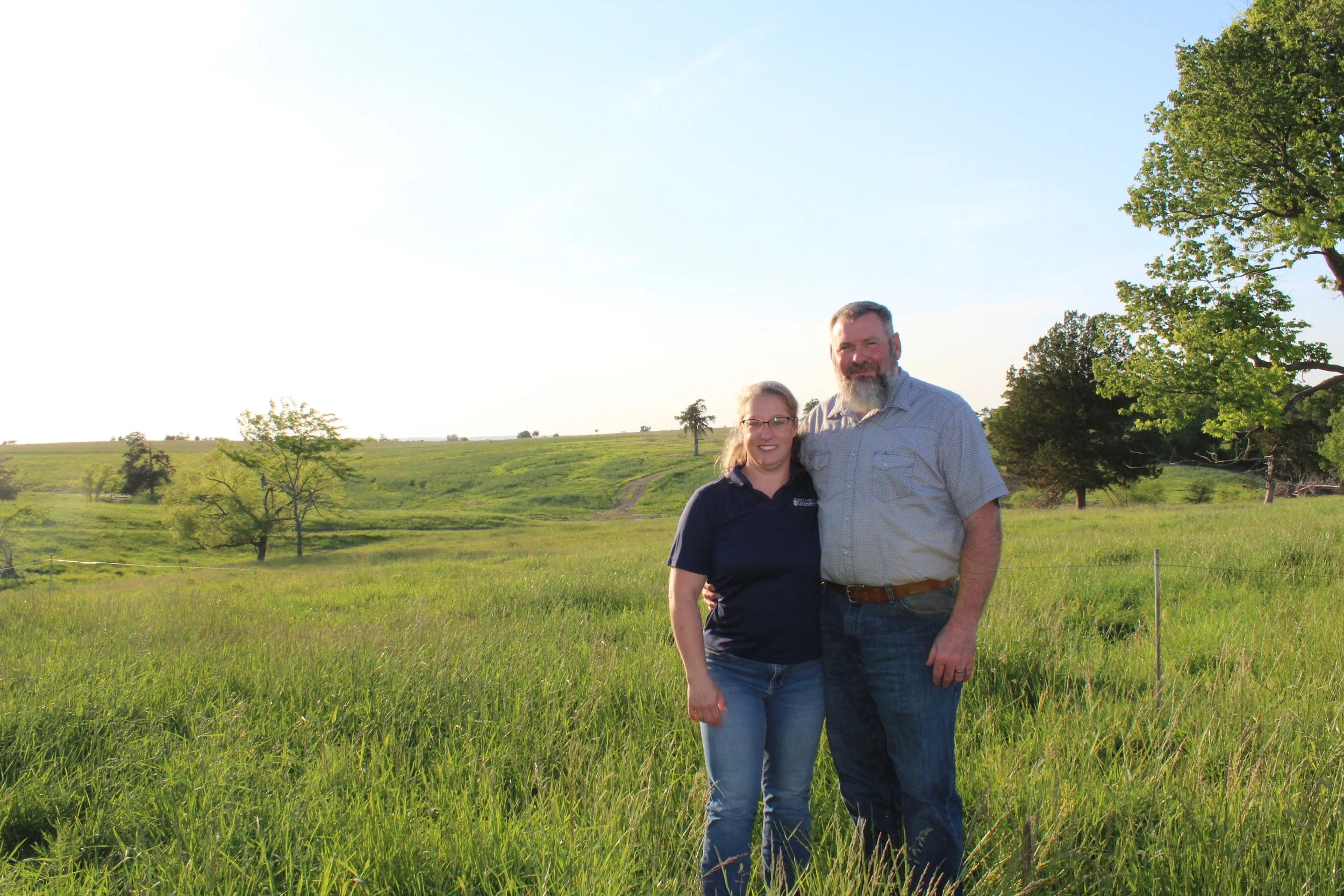
Mike and Kendra with the beautiful backdrop of their farm
A big thank you to Mike and Kendra for showing me their beautiful farm and allowing me and readers a peek inside their operations and lives. I was able to learn a lot and hope to take that knowledge with me to other farmers and other conversations I have in the future.
